Last month, I wrote about a semantic subspace in the word2vec model of the Stanford Encyclopedia of philosophy. The idea, in short, is that you can train an extremely simple word-embedding mode (word2vec) on a body of text and then search the embedding space of that model (that is, the vector space made of all the vectors representing each word) for patterns. One neat discovery is that even simple models appear to learn scales such as whether some animals are larger or smaller or faster or slower than each other, based purely on this word co-occurrence data. When I was playing with this method last month, I found that the model seems to develop a rough scale indicating whether or not a philosopher was ‘analytic’ or ‘continental’. I thought this was pretty neat and put the code here so that anyone can play around with it on the their own favorite data sets.
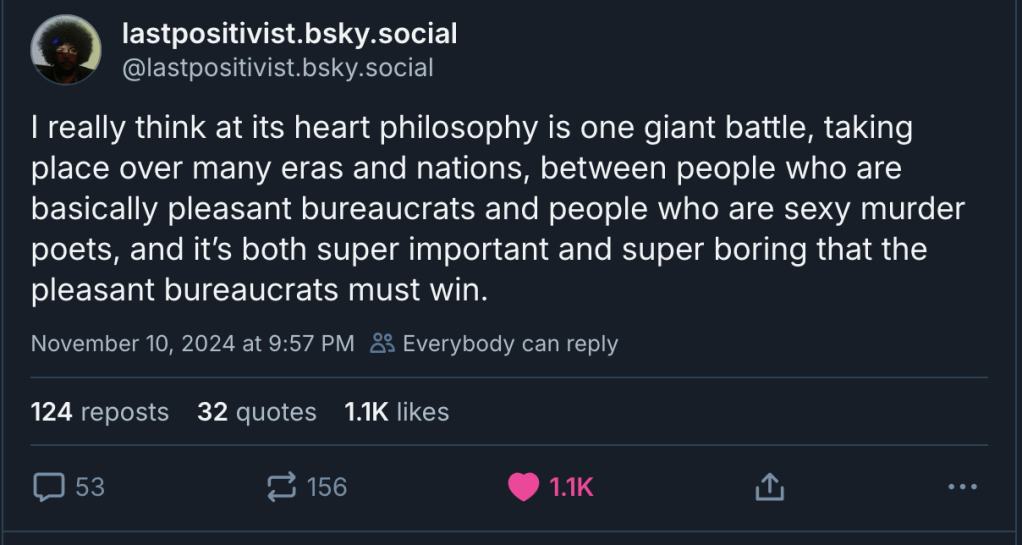
Of course, the analytic-continental distinction isn’t always the best way to understand 20th century philosophy (and it has largely been redundant since 01/05/2019) and recent work has found it more hermeneutically fecund to categorize a philosopher as either a ‘sexy murder-poet’ or ‘basically pleasant bureaucrat’. Since neither of these terms are yet attested in the Stanford Encyclopedia, I have had to settle with a simple poet-bureaucrat axis. I was surprised at how well it tracks some intuitions and I am curious about where it diverges. At the top, we have the most poet-like philosophers (Sartre, Heidegger, Nietzsche) and at the bottom, we have the most bureaucrat-like philosophers (Hempel, Lewis, Kripke). Sartre may have disliked poets, but his language is undeniably poetic while both Heidegger and Nietzsche explicitly wrote poetry. Hempel, meanwhile, has big bureaucrat vibes. Here are the results (with poet at the top and bureaucrat at the bottom).* Feel free to comment with suggestions for other names you would like to see examined. I used my 20th century philosophy list because I had it to hand but obviously I should generalize this to all the philosophers who showed up on my map of the Stanford Encyclopedia.

 fintanmallory.com